By Manassas Journal Staff
August 23, 2026
The property purchases and offer to buy a neighboring church have not led to a publicly identified project. They do, however, highlight Manassas’s role in Northern Virginia’s technology corridor.
August 23, 2026
2-Minute Brief
What happened: BlackChamber Partners reportedly acquired approximately 12 acres between Dean Drive and the Manassas Church of the Brethren for about $38.8 million. The data-center developer also reportedly offered to purchase the church’s adjoining seven-acre property.
What is confirmed: The transactions show developer interest in the area.
What is not confirmed: No publicly available record reviewed by the Manassas Journal identifies the size, electrical demand, water use, operator or construction schedule of a possible project on the assembled land.
Why it matters: Data centers are permitted by right in the City’s I-1 light-industrial and I-2 heavy-industrial districts. Manassas also has established technology employers, access to regional fiber optic networks and a City-operated electric utility.
Data Center Dynamics reported in June that BlackChamber Partners acquired the approximately 12 acres through Nova Pineapple Farms LLC. The reported purchase price equals roughly $3 million per acre.
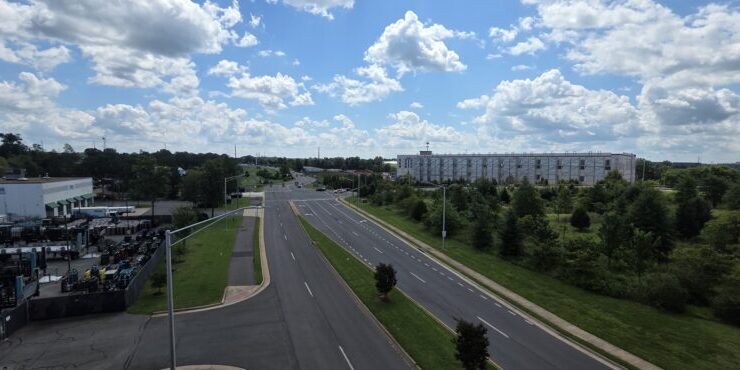
The properties are located between Dean Drive and the Manassas Church of the Brethren at 10047 Nokesville Road.
BlackChamber also reportedly offered to purchase the church’s seven-acre property. The offer amount was not disclosed, and the congregation had not agreed to sell when its minister addressed the Manassas City Council on June 8.
The reported transactions are land deals, not approval of another data center.
As of Aug. 23, the City’s public list of rezoning and special-use applications under review did not include the assembled properties. However, that does not rule out future development or administrative planning work.
Data centers are allowed by right in the City’s I-1 and I-2 districts. A project that meets the existing requirements may proceed through administrative site-plan, building-permit and utility reviews without a rezoning or site-specific special use permit hearing.
What is a data center?
A data center is a secure building that houses computer equipment used to store, process and move digital information.
When people save photographs, documents, emails or other information “in the cloud,” that information is stored on physical computer equipment inside data centers and accessed through the internet.
Operating that equipment requires reliable electricity, cooling systems, batteries, generators for backup power and high-capacity fiber-optic networks.
Fiber-optic lines act as the superhighways of the digital world, carrying large amounts of information quickly between data centers and users.
Why Manassas attracts data-center interest
Northern Virginia is the world’s largest data-center market. According to the Virginia Joint Legislative Audit and Review Commission, the region developed that position through its fiber networks, electrical infrastructure, available land, major customers and Virginia’s data-center tax incentive.
Data centers tend to cluster. Once an area has fiber routes, electrical connections, specialized contractors, experienced workers and operating facilities, nearby land can become more attractive for additional development.
Manassas already has major technology, manufacturing and defense operations, including Micron Technology, Lockheed Martin and BAE Systems. Digital Realty operates the Brickyard data center on Godwin Drive, and Amazon Web Services projects have been identified near Dean and Technology drives.
The City’s economic-development materials identify advanced manufacturing, technology, aerospace and defense as important parts of the local economy.
These conditions help explain developer interest. They do not mean every industrial property can support a data center. Electrical capacity, fiber access, parcel configuration, existing businesses, environmental conditions and other restrictions remain important.
What rules are in place?
Data centers must comply with the City’s zoning, building, fire, stormwater, environmental and utility requirements.
The City’s current industrial and data-center standards address:
- Setbacks from residential property and certain community uses
- Landscaping, buffers and opaque screening
- Placement and screening of cooling equipment and generators
- Building height and exterior appearance
- Noise studies before and after operations begin
- Site-plan, building, fire and utility review
- Additional requirements for water-cooled systems
The standards are explained in the City’s zoning ordinance materials and development standards.
The City does not establish a general minimum lot size specifically for data centers in I-1 or I-2. Developers may also purchase and combine adjoining properties.
A Manassas Journal review of the City’s public GIS data identified 473 records coded I-1 or I-2. Records with reported land-area information total approximately 819 acres, or about 13 percent of the City.
That figure measures zoning. It does not measure vacant, available or developable land. Many of those properties contain operating businesses or may lack the land, electricity or other conditions required for a data center.
What are the potential benefits and impacts?
Data centers can bring substantial private investment. Construction supports contractors, skilled trades and equipment suppliers. Operating facilities also employ workers in technology, security, maintenance and building operations.
They may generate local revenue from real estate and computer equipment taxes. The actual amount depends on the property, equipment ownership and tax status of the operator or tenant.
The City reports that the Brickyard data center generates approximately $1.2 million annually in real estate taxes. However, its bank tenant is taxed under Virginia’s bank-franchise tax system, so the City does not collect the computer-equipment tax revenue that could apply to many other tenants. The City explained the difference in a 2025 public notice.
Other project-specific considerations include electrical demand, cooling and water use, equipment noise, generator testing, construction traffic and proximity to homes or community uses.
History within the corridor
The Dean Drive, Foster Drive and Wellington Road area also contains documented African American history.
Rose Hill Cemetery, established in 1887, served Manassas’s Black community during segregation. The Jennie Dean memorial marks the school Dean founded in 1893 for African American students.
No public record reviewed for this article shows a current data-center project crossing either historic site. Their presence shows that industrial development and historic resources can occupy the same corridor.
What we’re watching
The Manassas Journal will continue tracking:
- Site plans and permit activity involving the assembled properties
- The status of the offer to the Manassas Church of the Brethren
- Electrical and water requirements for future projects
- Tax revenue from operating data centers
- Effects on nearby businesses and historic resources
Journal Note: This article distinguishes among confirmed public records, reported transactions and matters that remain unknown. Public GIS information is a reference tool and does not determine whether a property is available or developable. Only the City of Manassas can provide an authoritative zoning determination for a specific property.