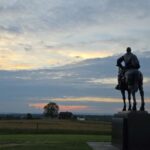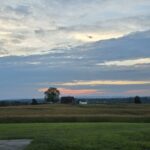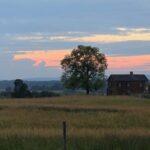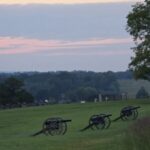
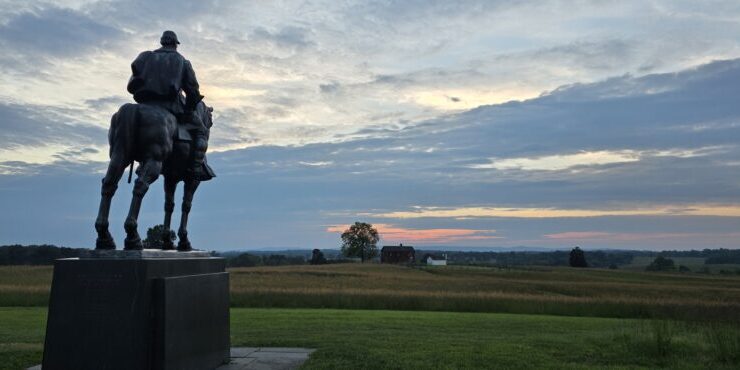
Eighty-six years after its dedication, the Stonewall Jackson monument still stands on Henry Hill, overlooking the preserved battlefield where the name was born.
2-MINUTE BRIEF
WHAT HAPPENED: The equestrian monument to Confederate Gen. Thomas J. Jackson at Manassas National Battlefield Park was dedicated Aug. 31, 1940.
WHY IT IS HERE: Jackson earned the nickname “Stonewall” during the First Battle of Manassas on July 21, 1861, after his Virginia brigade held its position on Henry Hill during heavy fighting.
WHY IT STILL MATTERS LOCALLY: Jackson’s name was closely connected to the Manassas area for generations. Local schools carried his name until 2020, and the monument is part of the federally preserved battlefield at Henry Hill.
TODAY: The National Park Service preserves and interprets the monument as part of Manassas National Battlefield Park.
Thomas J. Jackson arrived at the First Battle of Manassas on July 21, 1861, as a Confederate brigadier general.
He left with a name that would follow him into American history.
During the fighting on Henry Hill, Jackson positioned approximately 2,500 Virginians in a defensive line as Union forces pressed the Confederate position.
Confederate Brig. Gen. Barnard Bee, attempting to rally his men, pointed toward Jackson’s brigade and called out:
“There stands Jackson like a stone wall!”
The nickname spread quickly. Jackson became Stonewall Jackson, and his brigade became known as the Stonewall Brigade.
Gen. Bee, traditionally credited with giving Jackson the “Stonewall” nickname, was mortally wounded during the battle and died the following day.
Gen. Bee’s monument stands nearby on Henry Hill.
The Monument Came Nearly 80 Years Later
The large bronze statue familiar to generations of battlefield visitors was not placed there during Jackson’s lifetime.
The idea developed during preparations for the 75th anniversary of First Manassas in 1936.
The Virginia General Assembly appropriated $25,000 for the project, and the Virginia Museum of Fine Arts conducted a national competition to select a design.
The monument was unveiled and dedicated on Aug. 31, 1940.
The 1940 Dedication
Historian and biographer Douglas Southall Freeman delivered the principal address at the Aug. 31, 1940 dedication.
Jackson’s granddaughter, Julia Jackson Christian Preston, helped unveil the statue with Anne Hooe Rust, daughter of Virginia State Sen. John W. Rust, who presided over the ceremony.
New York sculptor Joseph Pollia won the design competition. Before creating the Manassas monument, he had also sculpted memorials to Union Gen. Philip Sheridan and abolitionist John Brown.
Pollia’s bronze equestrian statue remains one of the most recognizable landmarks at Manassas National Battlefield Park.
A Name That Became Part of Local Life
Jackson’s name remained part of the Manassas area for generations, including at Stonewall Jackson High School and Stonewall Middle School.
In 2020, both schools were renamed.
Stonewall Jackson High School became Unity Reed High School, honoring Arthur Reed, an Army veteran, retired Drug Enforcement Administration officer and longtime school security assistant who spent the final 13 years of his life working at the school and was remembered as a favorite among students.
Stonewall Middle School became Unity Braxton Middle School, honoring Celestine and Carroll Braxton.
Celestine Braxton taught for 33 years in Prince William County Public Schools and helped integrate local schools.
Carroll Braxton, now 102, grew up in Manassas and is a retired Marine Master Gunnery Sergeant. He was one of the Montford Point Marines, the first Black men admitted to the Marine Corps, served during World War II and the Korean War, and later received the Congressional Gold Medal. He remains closely connected to the Manassas community.
The new names honored local figures with deep ties to the Manassas community.
The battlefield monument remains on National Park Service property at Henry Hill, where Jackson’s brigade fought during the First Battle of Manassas.
The Monument in More Recent History
The monument has remained a prominent feature of Manassas National Battlefield Park for decades.
In October 2017, vandals poured white paint over the granite base and spray-painted the word “Dead!!!” on the monument.
National Park Service preservation specialists removed the paint while park law enforcement investigated the vandalism.
Today, Manassas National Battlefield Park preserves the ground where the First and Second Battles of Manassas were fought. Visitors can walk miles of trails, cross open fields, see historic landmarks and follow the landscape where the fighting unfolded.
For local residents, that history is close by. Henry Hill, the unfinished railroad and thousands of acres of preserved battlefield remain part of the landscape surrounding Manassas.
The monuments mark events from the past. The fields around them remain much as they have for generations, preserved for visitors to walk, study and experience.
Thomas J. Jackson came to Henry Hill in July 1861.
“Stonewall” Jackson left it.
SOURCES
- National Park Service, Stonewall Jackson Monument, Manassas National Battlefield Park
- National Park Service, First Battle of Manassas
- National Park Service, Bee Monument
- Prince William County Public Schools, school-name histories
- Encyclopedia Virginia, Thomas J. “Stonewall” Jackson
- National Park Service, 2017 Stonewall Jackson Monument vandalism
- Historian notes provided to the Manassas Journal regarding the Aug. 31, 1940 dedication ceremony and sculptor Joseph Pollia.